Complex Structure Five-Axis Machining Parts: Precision Engineering for the Most Demanding Applications
Introduction
In the ever-evolving field of modern manufacturing, the demand for high-precision and intricately shaped components continues to grow. Among the most advanced methods for producing such parts is five-axis machining, a cutting-edge technique that allows for exceptional accuracy, flexibility, and surface finish. Especially when dealing with complex structures, five-axis machining enables manufacturers to create components that would be virtually impossible using traditional three-axis systems.
This article explores the key aspects, advantages, applications, materials, and industry insights related to complex structure five-axis machining parts. Whether you are an engineer, product designer, procurement specialist, or industrial buyer, understanding the capabilities and advantages of five-axis CNC machining for complex parts can give you a competitive edge in the global manufacturing landscape.
What Is Five-Axis Machining?
Five-axis machining refers to a CNC (Computer Numerical Control) process where a cutting tool moves across five different axes simultaneously. These axes typically include the X, Y, and Z linear axes, along with two rotational axes—commonly referred to as A (rotation around the X-axis) and B or C (rotation around the Y or Z-axis).
This level of motion allows the machine to approach a workpiece from virtually any direction, which is essential when machining components with complex geometries, undercuts, or multiple angled surfaces. Unlike traditional three-axis machining, which requires multiple setups and fixtures, five-axis systems offer a more efficient and accurate way to produce high-complexity parts.
Why Five-Axis Machining for Complex Structures?
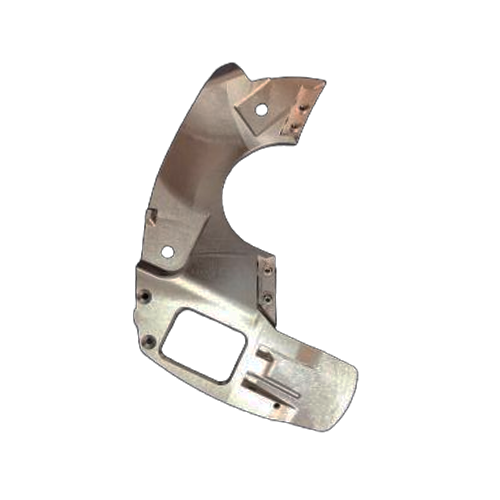
Components with complex structures often include freeform surfaces, compound curves, deep cavities, intricate holes, and multiple angles that are difficult or impossible to access using conventional machining methods. Five-axis machining excels in producing such parts due to:
Full geometric accessibility: The rotating axes allow the tool to reach hard-to-access surfaces in a single setup.
Fewer setups: Complex parts can often be fully machined in one or two setups, reducing cumulative error and lead time.
Improved surface finish: Continuous tool movement reduces tool marks and ensures smoother surfaces.
Higher accuracy: Multi-axis motion minimizes the need for part repositioning, enhancing dimensional accuracy.
Key Advantages of Five-Axis Machining for Complex Parts
1. Single Setup Machining
One of the biggest advantages of five-axis CNC machining for complex structures is the ability to complete all sides of a part in a single setup. This improves precision by eliminating the alignment errors associated with multiple repositionings.
2. Enhanced Tool Life and Surface Finish
With five-axis capabilities, the cutting tool maintains optimal orientation relative to the surface. This leads to more uniform cutting forces, reduced tool wear, and improved surface finishes—essential for aerospace, medical, and automotive applications.
3. Reduced Lead Time
Five-axis machining reduces the number of fixtures and setups required, resulting in faster turnaround times. This is particularly beneficial in prototyping or when working with low- to medium-volume production runs.
4. Improved Design Flexibility
Engineers and designers are free to innovate with more complex shapes and contours. Five-axis machining supports highly customized parts that meet strict design specifications without compromising manufacturability.
Applications of Complex Structure Five-Axis Machined Parts
Five-axis machining is widely used across industries where precision, complexity, and performance are critical. Here are some common sectors where complex parts benefit from this advanced machining process:
Aerospace and Defense
Five-axis machining is crucial in this sector because it meets strict tolerances and allows for lightweight, high-strength geometries using titanium and other exotic alloys.
Medical Devices
Orthopedic implants
Surgical instruments
Dental prosthetics
Microfluidic devices
The medical industry demands intricate shapes with biocompatible materials. Five-axis machining enables the production of complex contoured implants with ultra-fine surface finishes and consistent dimensional integrity.
Automotive and Motorsports
Five-axis machining enhances performance and weight efficiency by enabling intricate internal and external features in lightweight metals.
Robotics and Automation
Robotic arms and joints
Precision couplings
Gripper components
Servo motor housings
Robotics systems rely on high-precision parts for optimal functionality. Complex geometries and tight tolerances are achievable through five-axis processes.
Energy Sector
In high-stress, high-temperature applications, five-axis machining allows for the use of difficult-to-machine materials shaped into durable, intricate components.
Materials Used for Complex Five-Axis Machined Parts
Five-axis machining is highly versatile and supports a wide range of materials, including:
Aluminum: Lightweight and highly machinable; widely used in aerospace and automotive.
Titanium: Known for strength and corrosion resistance; ideal for medical and aerospace applications.
Stainless Steel: Durable and rust-resistant; used in surgical tools and industrial equipment.
Inconel and Super Alloys: Withstand extreme heat and pressure; used in turbines and nuclear systems.
Plastics and Composites: Suitable for lightweight, non-conductive, or chemical-resistant applications.
Material selection depends on the intended application, structural requirements, and cost considerations.
Design Considerations for Complex Five-Axis Parts
While five-axis machining offers extensive freedom in design, some best practices can enhance manufacturability:
Minimize deep pockets: Deep cavities can be machined, but may require extended tools or special setups.
Avoid sharp internal corners: Rounded internal features are easier to machine and less prone to stress.
Ensure tool access: Even with five-axis flexibility, design features must be accessible to the tool from some angle.
Balance complexity and cost: Increased complexity can raise machining time and cost; balance function with budget.
Working with experienced engineers during the design phase can help optimize the part for five-axis production.
Quality Assurance in Five-Axis Machined Parts
Due to the complexity of these components, rigorous quality control is essential. Common inspection methods include:
Coordinate Measuring Machines (CMMs): Used to verify dimensional tolerances.
Laser scanning: Captures 3D surface data for reverse engineering or inspection.
Visual inspection and surface finish analysis: Ensures cosmetic and functional integrity.
Experienced five-axis machining providers often operate under ISO 9001, AS9100, or medical-grade certifications to ensure consistency and traceability in production.
Choosing the Right Supplier for Complex Five-Axis Machining
Selecting the right manufacturing partner is critical when sourcing complex parts. Key factors to consider include:
Technical capabilities: Do they have advanced five-axis equipment and CAD/CAM software?
Experience: Look for proven expertise in your industry or application.
Material handling: Can they work with the specific metals or composites your design requires?
Quality control: Are they certified and equipped to verify tight tolerances?
Lead time and scalability: Can they meet your timeline and adapt to changing volumes?
A trusted partner will also offer design-for-manufacturing (DFM) feedback, helping to streamline the process from prototype to production.
Future of Complex Five-Axis Machining
As automation, artificial intelligence, and Industry 4.0 practices advance, five-axis machining is evolving to be even more precise and efficient. Emerging trends include:
Hybrid manufacturing: Combining additive and subtractive processes.
Automated toolpath optimization: AI-powered CAM systems improve tool engagement and efficiency.
Real-time feedback and adaptive control: Enhances machining accuracy in real-time.
Nanometer-level precision: For micro-machining in electronics and biomedical devices.
These advancements will make five-axis machining more accessible, cost-effective, and capable of producing the next generation of high-performance parts.
Conclusion
Complex structure five-axis machining parts represent the pinnacle of precision manufacturing. With unmatched versatility, accuracy, and efficiency, five-axis CNC machining allows engineers and designers to push the boundaries of what is possible. From aerospace and medical to automotive and robotics, the ability to produce complex geometries in a single setup with tight tolerances makes five-axis machining an invaluable solution for modern industries.
By partnering with experienced machining professionals and leveraging the full potential of multi-axis technology, companies can create innovative products, improve performance, and stay competitive in a fast-changing global market.
If your project requires complex, high-precision parts, five-axis machining is the key to unlocking design freedom and production excellence.

 Español
 Portugues
 Pусский
 Français
 Deutsch
 日本語
 한국어
 العربية
 Italiano
 Nederlands
 Ελληνικά
 Svenska
 Polski
 ไทย
 Türk dili
 हिन्दी
 Indonesia
 Melayu
 Tiếng Việt
 中文
 dansk
 Magyar
 қазақ
 বাংলা
 עִברִית
 čeština
 Soomaali
 မြန်မာ
 فارسی
 українська
 norsk
 Gaeilge
 беларускі
 Română
 Filipino
 lietuvių
 македонски
 Suomalainen
 slovenský
 o'zbek
 اردو
 հայերեն
 Igbo
 български
 سنڌي
 සිංහල
 Hrvatski
 íslenskur
 Zulu South Africa
 Afrikaans isiXhosa
 ಕನ್ನಡ
 Indonésia Sunda
 Кыргызча
 тоҷикӣ
 Србија
 Hawaii
 Cebu
 नेपाल
 latvija
 slovenija
 kiswahili
 ਪੰਜਾਬ
 پښتو
 Azərbaycan
 አማራ
 Shqipëria
 Chicheva
 ଓଡିଆ
 Setswana
 Afrikaans
 Aymara
 Башҡорт
 Türkmenler
 ትግሪኛ
 Afaan Oromoo
 অসমীয়া
 Kinyarwanda
 Ilocano
 Wolof
 अवधी
 Oluganda
 Bikol
 Fulɓe
 Kikongo
 Lingala
 རྫོང་ཁ
 Santali
 Аҧсуа
 Чӑваш
 Batak Karo



 Phone