Precision Five-Axis Aluminum Alloy Machining: High-Performance Manufacturing for Complex Parts
Introduction
In the realm of advanced manufacturing, precision five-axis aluminum alloy machining has revolutionized the way complex parts are created. It represents the pinnacle of subtractive manufacturing, offering unprecedented flexibility, accuracy, and efficiency. By allowing simultaneous movement along five axes, this machining technology makes it possible to create intricate geometries with minimal setup, high precision, and excellent surface finishes.
Aluminum alloy, known for its light weight, high strength-to-weight ratio, excellent machinability, and corrosion resistance, is the ideal material for five-axis CNC machining applications across multiple industries. Whether it's aerospace, automotive, electronics, medical, or robotics, precision five-axis aluminum machining ensures high-performance parts tailored to strict technical standards.
In this comprehensive guide, we will explore every critical aspect of five-axis aluminum alloy machining — from its principles and advantages to applications, design considerations, machining processes, and quality assurance strategies.
What Is Five-Axis CNC Machining?
Five-axis CNC (Computer Numerical Control) machining refers to the capability of a machine tool to move a part or cutting tool in five different axes simultaneously — three linear axes (X, Y, Z) and two rotational axes (A, B). Unlike traditional three-axis machines, five-axis systems allow for much greater freedom of movement and orientation during the cutting process.
This extra flexibility allows the tool to approach the workpiece from any direction, reducing the need for multiple setups and fixtures. The result is faster production cycles, higher accuracy, and greater ability to machine complex, contoured surfaces — particularly beneficial when working with aluminum alloys.
Why Choose Aluminum Alloy for Five-Axis Machining?
1. Excellent Machinability
Aluminum is a soft, ductile material with low density and high thermal conductivity, which allows for faster cutting speeds and better chip removal. This leads to reduced tool wear and improved production efficiency.
2. Superior Strength-to-Weight Ratio
Aluminum alloys such as 6061, 7075, and 2024 offer impressive mechanical properties. They provide structural strength comparable to some steels but at only a fraction of the weight, making them ideal for lightweight structural applications.
3. Corrosion Resistance
Most aluminum alloys form a natural oxide layer that provides strong corrosion protection. This makes aluminum parts suitable for outdoor and harsh environments without extensive coating or post-processing.
4. Thermal and Electrical Conductivity
Aluminum has good heat dissipation and electrical conductivity, which is especially beneficial in electronic housings, heat sinks, and motor components.
5. Recyclability and Sustainability
Aluminum is highly recyclable, making it an environmentally friendly option for precision parts manufacturing. The energy required to recycle aluminum is just 5% of the energy needed for primary production.
Key Advantages of Precision Five-Axis Aluminum Alloy Machining
1. Reduced Setup and Clamping Time
Five-axis machines can reach all surfaces of a part in a single setup, eliminating the need for repositioning or refixturing. This reduces setup time, increases throughput, and minimizes human error.
2. Complex Geometry Capabilities
Five-axis machining is particularly useful for complex parts with curved surfaces, undercuts, deep cavities, or contoured edges. It enables high-precision cutting even in hard-to-reach areas, which would be impossible or highly inefficient with three-axis machines.
3. Tighter Tolerances and Better Surface Finish
The simultaneous movement of all five axes ensures smooth transitions, consistent cutting paths, and high repeatability. This leads to tighter tolerances and better surface finishes, reducing the need for secondary finishing.
4. Faster Production Cycles
With fewer setups and efficient tool paths, cycle times are significantly shorter. Combined with high-speed spindles and precision tooling, five-axis machining delivers parts faster without sacrificing quality.
5. Tool Life Optimization
Because the tool can be oriented to the optimal cutting angle, it reduces stress on the tool, enhances chip evacuation, and improves heat dissipation — leading to longer tool life.
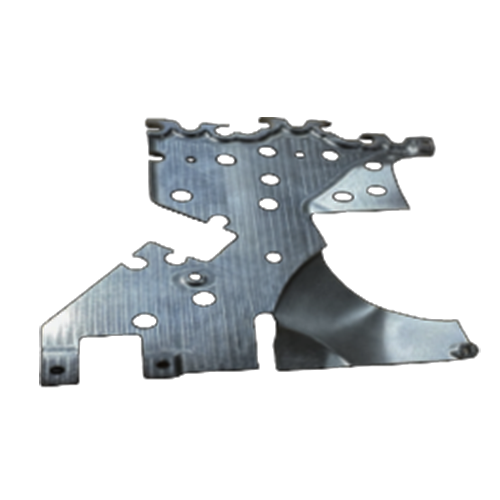
Common Applications of Five-Axis Machined Aluminum Parts
Aerospace and Aviation
Automotive and Motorsport
Medical and Healthcare
Electronics and Robotics
Defense and Military
Precision Five-Axis Machining Workflow for Aluminum Alloy
1. Material Selection and Preparation
Selecting the appropriate aluminum alloy (e.g., 6061-T6, 7075-T6, 2024-T3) depends on the application’s strength, thermal, and corrosion resistance requirements. The raw aluminum is inspected, cut, and secured on the machine bed.
2. CAD Design and CAM Programming
Design engineers create detailed 3D CAD models. CAM software translates these into toolpaths optimized for five-axis movement. Simulation and verification ensure that tool collisions, overcuts, and inefficiencies are addressed before actual machining.
3. Tooling and Fixturing
High-precision cutting tools, end mills, and drills are selected based on part geometry and material properties. Custom fixtures or vises are sometimes used to hold the part securely during high-speed operations.
4. Roughing and Finishing Operations
The part is initially roughed to remove excess material quickly. Then, finer finishing passes are made to achieve the final geometry, dimensional accuracy, and surface finish.
5. Inspection and Quality Control
After machining, the part is thoroughly inspected using coordinate measuring machines (CMM), micrometers, or laser scanning to ensure all tolerances and specifications are met.
6. Post-Processing (If Required)
Anodizing, polishing, bead blasting, or painting may be applied depending on functional or aesthetic requirements. Aluminum’s excellent surface qualities make it ideal for both decorative and protective finishes.
Design Considerations for Five-Axis Machined Aluminum Parts
To take full advantage of five-axis machining, part designers should consider the following:
Avoid Deep Cavities: Deep pockets are harder to machine and may require longer tools, increasing the risk of deflection.
Maintain Uniform Wall Thickness: Uneven wall thickness can cause distortion during machining or thermal expansion in service.
Include Radius on Internal Corners: Sharp corners are difficult to machine and cause tool wear. Filleted corners are easier to achieve and improve part strength.
Minimize Tool Changes: Designing parts that allow machining with fewer tool changes can reduce cycle time and increase accuracy.
Collaborating closely with experienced CNC programmers during the design stage ensures the part is optimized for five-axis machining.
Tolerances and Surface Finish
Five-axis CNC machining delivers extremely tight tolerances, often in the range of ±0.005 mm or better for precision aluminum components. The surface roughness can reach Ra 0.4 µm or lower with proper tooling and machine settings.
Surface finish can be enhanced by:
Cost Factors in Five-Axis Aluminum Machining
Several factors influence the cost of five-axis aluminum machining:
Material Type: High-performance alloys like 7075 are more expensive than standard 6061.
Part Complexity: More intricate geometries require longer machining times and complex toolpaths.
Tolerances and Finish: Tighter tolerances and finer surface finishes require more time and specialized tools.
Volume and Batch Size: Larger production runs reduce per-part costs due to economies of scale.
Tool Wear and Maintenance: High-speed machining demands frequent tool inspection and replacement.
Although five-axis machining can be more expensive than simpler methods, the quality, speed, and accuracy often justify the investment — especially for high-value applications.
Quality Assurance and Certification
Quality control is critical in five-axis aluminum machining. Most top-tier manufacturers follow rigorous inspection protocols and maintain certifications such as:
ISO 9001 (Quality Management)
ISO 13485 (Medical Device Manufacturing)
AS9100 (Aerospace Industry Quality)
ITAR Compliance (Defense Manufacturing)
These certifications guarantee that each machined component meets performance, safety, and consistency standards required by global industries.
Conclusion
Precision five-axis aluminum alloy machining stands at the forefront of modern manufacturing. It enables the production of highly complex, lightweight, and durable components with exceptional accuracy. Combining the versatility of five-axis movement with the desirable properties of aluminum alloys allows industries to meet demanding engineering challenges in innovative ways.
From aerospace and automotive to electronics and medical technology, five-axis CNC machining has become the preferred choice for manufacturers seeking quality, reliability, and efficiency. As technology continues to advance, the capabilities of five-axis aluminum machining will only grow stronger — paving the way for smarter, faster, and more sustainable production.

 Español
 Portugues
 Pусский
 Français
 Deutsch
 日本語
 한국어
 العربية
 Italiano
 Nederlands
 Ελληνικά
 Svenska
 Polski
 ไทย
 Türk dili
 हिन्दी
 Indonesia
 Melayu
 Tiếng Việt
 中文
 dansk
 Magyar
 қазақ
 বাংলা
 עִברִית
 čeština
 Soomaali
 မြန်မာ
 فارسی
 українська
 norsk
 Gaeilge
 беларускі
 Română
 Filipino
 lietuvių
 македонски
 Suomalainen
 slovenský
 o'zbek
 اردو
 հայերեն
 Igbo
 български
 سنڌي
 සිංහල
 Hrvatski
 íslenskur
 Zulu South Africa
 Afrikaans isiXhosa
 ಕನ್ನಡ
 Indonésia Sunda
 Кыргызча
 тоҷикӣ
 Србија
 Hawaii
 Cebu
 नेपाल
 latvija
 slovenija
 kiswahili
 ਪੰਜਾਬ
 پښتو
 Azərbaycan
 አማራ
 Shqipëria
 Chicheva
 ଓଡିଆ
 Setswana
 Afrikaans
 Aymara
 Башҡорт
 Türkmenler
 ትግሪኛ
 Afaan Oromoo
 অসমীয়া
 Kinyarwanda
 Ilocano
 Wolof
 अवधी
 Oluganda
 Bikol
 Fulɓe
 Kikongo
 Lingala
 རྫོང་ཁ
 Santali
 Аҧсуа
 Чӑваш
 Batak Karo



 Phone